
3 Minute Read
It has been encouraging to watch states take increasingly aggressive action over the past several years to combat children’s access to online pornography. To date, seventeen states have enacted age-verification laws, with several more considering similar legislation. While these laws vary in strength, no state has achieved the level of success seen in Texas—and much of that success comes down to one thing: enforcement.
This wave of legislation began in 2022 when freshman Louisiana Representative Laurie Schlegel, after learning about singer Billie Eilish’s public account of childhood exposure to pornography, championed the nation’s first state age-verification law with the assistance of author and researcher Dr. Gail Dines. The bill received overwhelming bipartisan support, passing almost unanimously in both chambers of the Louisiana Legislature.
Immediately after becoming law, it was challenged by the Free Speech Coalition, the pornography industry’s primary trade association. The lawsuit was ultimately dismissed, clearing the way for other states to pursue similar legislation.
Once Louisiana’s law took effect, Pornhub acknowledged to CNN that traffic to its website dropped by approximately 80% within the state. Rather than broadly complying with new age-verification laws, Pornhub later chose to block access in many states that enacted them.
Louisiana also discovered that while the largest pornography websites generally complied, many smaller websites simply ignored the law. To address that problem, lawmakers passed the PAVE Act during the following legislative session, empowering the Attorney General to investigate violations and impose substantial civil penalties on non-compliant websites.
Texas took Louisiana’s framework a step further.
In 2023, Texas passed House Bill 1181, incorporating many of Louisiana’s provisions while strengthening its enforcement mechanisms. Like Louisiana’s law, Texas’ legislation faced constitutional challenges. Most of the law was ultimately upheld, with only the compelled-warning provision on website landing pages being struck down.
Writing for the majority, Judge Jerry Smith explained that requiring online age verification is no different than requiring proof of age before purchasing pornographic magazines in person—a practice upheld by the U.S. Supreme Court in Ginsberg v. New York (1968). Treating the internet differently, he wrote, “implies that the invention of the Internet somehow reduced the scope of the state’s ability to protect children.”
But Texas distinguished itself not simply by passing the law—it enforced it.
In February 2024, only three months after prevailing in court, Attorney General Ken Paxton filed suit against Aylo Global Entertainment, the parent company of Pornhub and several other major pornography websites, seeking approximately $1.6 million in penalties, plus $10,000 per day for violating HB 1181.
Rather than comply with Texas law, Pornhub shut down access to its website throughout the state.
Responding to the decision, Attorney General Paxton stated:
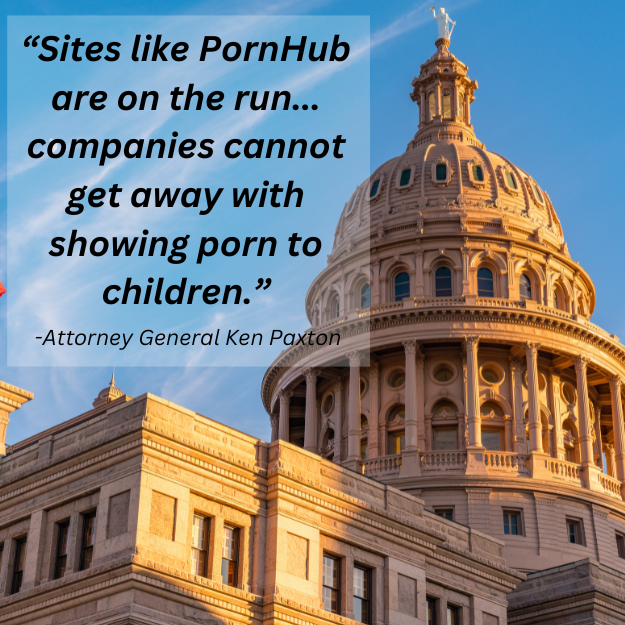
“PornHub has now disabled its website in Texas. Sites like PornHub are on the run because Texas has a law that aims to prevent them from showing harmful, obscene material to children. In Texas, companies cannot get away with showing porn to children. If they don’t want to comply, they should leave Texas.”
The following month, Paxton sued two additional companies—Multi Media, LLC, which operates Chaturbate, and Hammy Media, which operates xHamster—for failing to implement meaningful age verification and instead relying on simple “I am 18 or older” click-through buttons.
Texas sought civil penalties exceeding $1.6 million against each company, along with an additional $10,000 per day for continued violations. The state ultimately collected $675,000 from Chaturbate and successfully compelled the company to implement age verification.
These cases illustrate an important principle: legislation alone does not solve the problem. Laws are only as effective as the willingness of governments to enforce them. Pornography companies will comply in proportion to the seriousness with which violations are investigated and prosecuted.
Texas has provided the clearest example of what meaningful enforcement looks like. It demonstrated that strong legislation, backed by determined enforcement, can dramatically reduce children’s access to online pornography.
Our hope is that more states—and ultimately the federal government—will follow Texas’ example by not only passing age-verification laws but enforcing them with the seriousness necessary to protect children nationwide.